
Recently there's a thriving category of AI systems designed to help with your work. Instead of waiting for your next prompt, they can take a goal, plan steps, and use tools to achieve it. That's the basic idea behind "agentic AI".
The term sounds like another fancy AI word — and in some marketing contexts, it is used loosely — but it also points to something meaningful: A shift in how AI systems are designed and what they can do.
In this article, I'll explain what agentic AI is, how it differs from the AI most of us are already familiar with, how it works under the hood, and where it's genuinely useful versus where you should still be cautious.
In this article
A Plain-English Agentic AI Definition
Agentic AI refers to AI systems designed to pursue goals through a sequence of planned steps, rather than producing a single response and stopping.
The word "agentic" comes from the concept of agency — the capacity to take action in order to reach an objective.
That doesn't mean these systems have intentions or consciousness. It means they're built to do more than answer a question.
Given a goal, an agentic AI system, or AI agent, can break it into smaller tasks, figure out what information or tools it needs, carry out actions, assess the results, and adjust its approach — all within a single workflow, with limited moment-to-moment human direction.
You can look at these five characteristics to see if an AI is genuinely agentic:
-
Goal-directed behavior
it works toward an objective rather than just responding to each prompt in isolation
-
Multi-step planning
it breaks complex tasks into a sequence of smaller actions
-
Contextual memory
it retains information across steps, so each action builds on what came before
-
Tool use
it can connect to external systems like databases, APIs, calendars, or search engines
-
Adaptation
it adjusts its approach based on what it finds along the way
An agent can handle an entire workflow on its own, or coordinate several specialized agents. The architecture varies, but the underlying idea holds: this is AI designed to plan and execute, not just respond.
Agentic AI vs Traditional AI and Generative AI
The easiest way to understand agentic AI is to see it alongside the two categories it's often compared to.
Traditional AI
Traditional AI describes systems built for specific, well-defined tasks. A spam filter, a fraud detection model, a product recommendation engine — these are all traditional AI in the broad sense.
They're optimized for narrow outputs: classify this email, score this transaction, rank these products. They're useful precisely because they do one thing reliably. But they don't plan, adapt to new situations, or chain actions together.
Generative AI
Generative AI is what most people have become familiar with through chatbots and writing assistants. These systems create content — text, images, code, summaries — based on what you ask.
They're impressively capable within a conversation, but they're fundamentally reactive. You prompt, they respond. Generative AI is often a component inside agentic systems, but on its own it's still waiting for instruction.
Agentic AI
Agentic AI represents systems designed to act autonomously to achieve complex, multi-step goals. Instead of just returning a single output or waiting for step-by-step instructions, an agentic system takes a high-level objective and figures out how to accomplish it.
These agents can break down a problem, plan a sequence of actions, utilize external tools or APIs, evaluate their own progress, and adapt their strategy if they hit a roadblock. They take the capabilities of traditional and generative AI and pair them with autonomous execution.
The short version: traditional AI predicts, generative AI creates, agentic AI coordinates actions toward an outcome.
The distinction isn't just technical — it changes what these systems can actually accomplish in a real workflow.
How Agentic AI Works: The Basic Workflow
The best mental model for agentic AI is a flow — often described as think, act, and deliver.
Receive a Goal
It starts with a goal. Someone sets an objective: research this topic, resolve this support ticket, monitor inventory and recommend a reorder. The goal can be straightforward or relatively open-ended, but it gives the system something to orient around.
Reason & Plan
Then comes reasoning and planning. Rather than immediately doing something, the system interprets the goal and figures out the steps required. It might identify that it needs to search for information before it can draft anything, or that a certain task depends on completing another one first.
This planning phase is one reason agentic systems feel qualitatively different from a chatbot — they're not just pattern-matching to your input; they're figuring out a path forward.
Check Memory
Memory keeps the workflow coherent. As the system works through its steps, it holds onto what it's already done, what it's learned, and what constraints apply. This isn't the same as a human's memory, but it's enough to prevent the system from losing track of earlier steps or repeating work it's already completed.
Use Tools
Tool use is where an agentic AI starts to have impacts on the real world. It uses tools to look things up, retrieve records, schedule meetings, send notifications, or trigger actions in other systems. This is also where the stakes go up, which we'll come back to.
Deliver
Finally, the AI delivers the results, and you can check whether it achieved your goal.
Real tasks often go wrong on the first try. So some agentic AIs whether they produced the right results, and, if not, adjusts their approach and try again. This iterative quality is part of what makes agentic systems better suited to complex work than one-shot prompts.
Common Architectures of Agentic AI: One Agent or Many?
Agentic AI systems aren't all built the same way. The right design depends on how complex the task is and how much coordination it requires.
Single-Purpose Agents
This type of AI agent handles one bounded workflow. A support agent that gathers account details, checks a knowledge base, and prepares a recommended response is a simple example. These are the easiest to build reliably, since the scope is limited and the rules are clear.
Hierarchical Systems
Hierarchical systems add a layer of coordination. One "manager" agent handles planning and oversight while delegating to "worker" agents that handle specific subtasks.
Picture a research project: one agent outlines the structure, another searches for information, a third drafts sections, and a fourth reviews for accuracy. Each does its part; the manager keeps it on track.
Peer-to-Peer Multi-Agent Systems
Peer-to-peer multi-agent systems take a more collaborative approach, with several agents working alongside each other rather than in a top-down structure. This can work well for complex workflows where different specializations need to interact fluidly.
But it also introduces more coordination complexity. When agents depend on each other, a mistake in one can ripple through the rest.
More agents and more connections generally mean more flexibility, but also more surface area for things to go wrong.
The Benefits of Agentic AI
The appeal of agentic AI is straightforward: it can work through a task rather than waiting to be prompted at every turn.
For multi-step digital work, that's a meaningful change. Instead of a person juggling between five different systems, an agent can do that coordination automatically, surfacing a result for review rather than requiring someone to drive the whole process.
There's also genuine potential for productivity gains in the right contexts. If an agent can handle the routine, process-heavy parts of a workflow, the people involved can focus more on judgment, exceptions, and the decisions that actually require human discretion.
Need an Agentic AI for Your Work or Study?
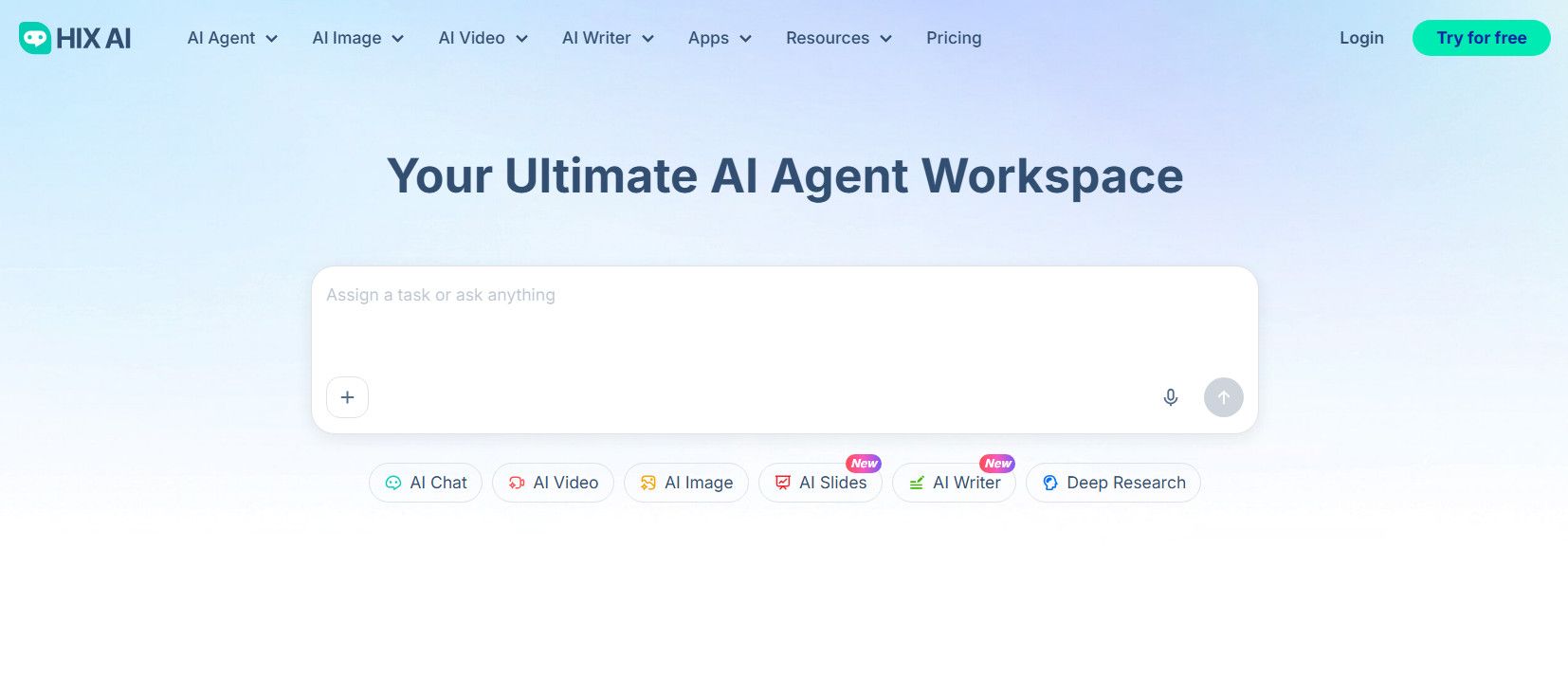
If you need an agentic AI that can boost your productivity, we suggest you give HIX AI a try!
HIX AI is your ultimate AI agent workspace. It brings in the specialized agents working together to help you deal with complex, multi-step tasks. It automatically plans the workflow, executes the steps and delivers the high quality results you need.
What you can do with HIX AI is limitless: from researching complex topics deeply, creating insightful AI slides or reports, to creating viral marketing assets or building data-driven websites. Just tell it your goal, and watch it handle everything perfectly from start to finish.
HIX.AI
4.9/5.0
Your ultimate AI agent workspace to boost your work and study productivity.
- Handle complex, multi-step tasks with simple prompts.
- Multiple expert-like subagents coordinated to complete your tasks.
- Powered by cutting-edge AI models.
- Research deeply and create professional reports/slide decks.
- Create on-brand, consistent marketing assets in one flow.
- Generate publish-ready visual documents and functional code.
The Limits and Risks of Agentic AI
This is the part that doesn't always get enough attention, especially in the more enthusiastic coverage of the topic.
- Hallucinations and error propagation: Agentic AI systems can generate plausible-sounding information that isn't accurate — and in a multi-step agentic workflow, a wrong assumption early on doesn't just appear in one answer. It gets acted upon and may be embedded in several layers of work. That's harder to catch than a single incorrect sentence in a chat response.
- Cost and technical complexity: Building and maintaining a reliable agentic system requires significant engineering effort. And even if you use a pre-configured AI agent, the costs can be surprising when running a single task.
- Human oversight is still essential: A fully autonomous agentic AI is still a Sci-Fi concept. You'll still have to overlook and sometimes intervene in what they are doing. And high-stakes actions, irreversible decisions, and anything that touches sensitive data should almost always include explicit approval and auditing, not just autonomous execution.
What to Actually Take Away
Here's the simplest way to carry this forward: agentic AI is AI that doesn't just generate outputs — it pursues goals. It plans, it uses tools, it remembers what it's already done, and it keeps going until the task is complete or a human steps in.
That makes it genuinely better suited to certain kinds of work than a one-shot chatbot. Multi-step tasks, coordination across systems, workflows that require pulling information from several places — these are where agentic approaches can add real value.