
You've probably seen the phrase many times — in tech news, product launch announcements, social media posts, … But what is an AI agent, really?
Most people think of it as a smarter chatbot. You ask something, it answers back, but this time it feels a bit more capable.
That's not it.
Instead of conversing with you, an AI agent takes a goal and works toward it across a series of decisions and actions. It uses whatever tools it has, and you don't need to hold its hand through every step.
That shift — from answering to handling multi-step tasks — is what makes AI agents genuinely new.

In this article
- What Is an AI Agent?
- How Is an AI Agent Different From a Chatbot?
- How Does an AI Agent Actually Work?
- Need an AI Agent That Can Handle Any Task?
- Where Are AI Agents Being Used Right Now?
- Why Do People Actually Find Agents Useful?
- The Downsides of AI Agents
- A Quick Word on "Agentic AI"
- What's Coming Next for AI Agents
So What Is an AI Agent?
Here's the clearest way I can put it: an AI agent is an AI system that takes a goal and figures out how to achieve it on its own.
You set the destination by providing your prompt. The agent plots the route, coordinates the tools, takes the steps, and adjusts along the way. It's not waiting for you to hand-hold it through every move. It perceives information from its environment, makes decisions about what to do next, uses tools to take action, and updates its approach when things change.
If you want to pin down what makes something a genuine AI agent, look for these qualities:
- Goal-directedness — it's working toward an outcome, not just generating a reply
- Decision-making — it actively chooses among options
- Tool use — it has its own sub-agents, or can reach into external systems: the web, databases, calendars, software
- Adaptability — it changes tack when new information shows up
- Autonomy — it can move forward without someone prompting every single step
That last one — autonomy — is worth pausing on. It doesn't mean the agent is infallible or that it operates in a vacuum. It just means it doesn't need a human hand on the wheel at every moment. That's both what makes agents powerful and what makes them worth watching carefully.
How Is This Different From a Chatbot?
This is where a lot of confusion lives, partly because some companies are happy to let the confusion exist. "Agent" is a flashier word than "chatbot," and not everyone uses it honestly.
Here's a clean way to think about the difference:
| System Type | What It Actually Does |
|---|---|
| Chatbot | Answers your question when you ask it |
| Virtual assistant | Helps with tasks, one prompt at a time |
| Automation script | Follows a rigid set of if-then rules |
| AI agent | Plans a sequence of steps, picks the right tools, and pursues a goal across multiple actions |
A chatbot is reactive — it waits, responds, and stops. An automation script follows a fixed track — it can't deviate if something unexpected happens. An AI agent can do both of those things and more: it can plan, improvise, use different tools depending on what's needed, and keep going toward the goal across many steps.
There's even a term floating around for when companies stretch the word too far: agent-washing. It describes the practice of slapping the "agent" label on tools that are really just repackaged scripts or assistants — things that lack genuine autonomy, can't recover gracefully from surprises, and need constant human guidance to function.
If a system can't act, adapt, and recover on its own with reasonable reliability, it's not really agentic, whatever the marketing says.
How Does an AI Agent Actually Work?
Most modern AI agents are built on top of a large language model — the same kind of technology that powers the chatbots you've probably already used. Think of the language model as the brain: it interprets goals, reasons through problems, and figures out what to do.
But the language model alone isn't what makes something an agent. What transforms it is the architecture built around it.
There are three building blocks that show up in essentially every real-world agent:
-
The reasoning engine (LLM)
This is the core intelligence. It reads instructions, interprets the situation, decides on a course of action, and communicates results. Without this, there's no understanding — just pattern-matching.
-
Memory
An agent without memory is like a colleague with amnesia who forgets everything between meetings. Memory lets an agent retain context from earlier steps, remember your preferences, and build on what it's already done rather than starting from scratch every time.
-
The ability to act
This is what separates an agent from a plain language model. It has access to tools — a browser, a calendar, a database, an API, a software interface — that let it do things, not just say things.
Beyond these three, many agents include a planning module that breaks a big, complex goal into smaller, more manageable sub-tasks.
And increasingly, you see agents designed to work in collaboration — with human reviewers, or with other specialized agents, each handling a piece of a larger puzzle.
The underlying operating loop looks something like this:
- Receive a goal
- Gather relevant information
- Decide what to do next
- Take an action using a tool
- Evaluate the result
- Adjust, continue, escalate, or stop
This cycle — sense, plan, act, reflect — is what gives an agent its apparent intelligence. It's not magic; it's iteration.
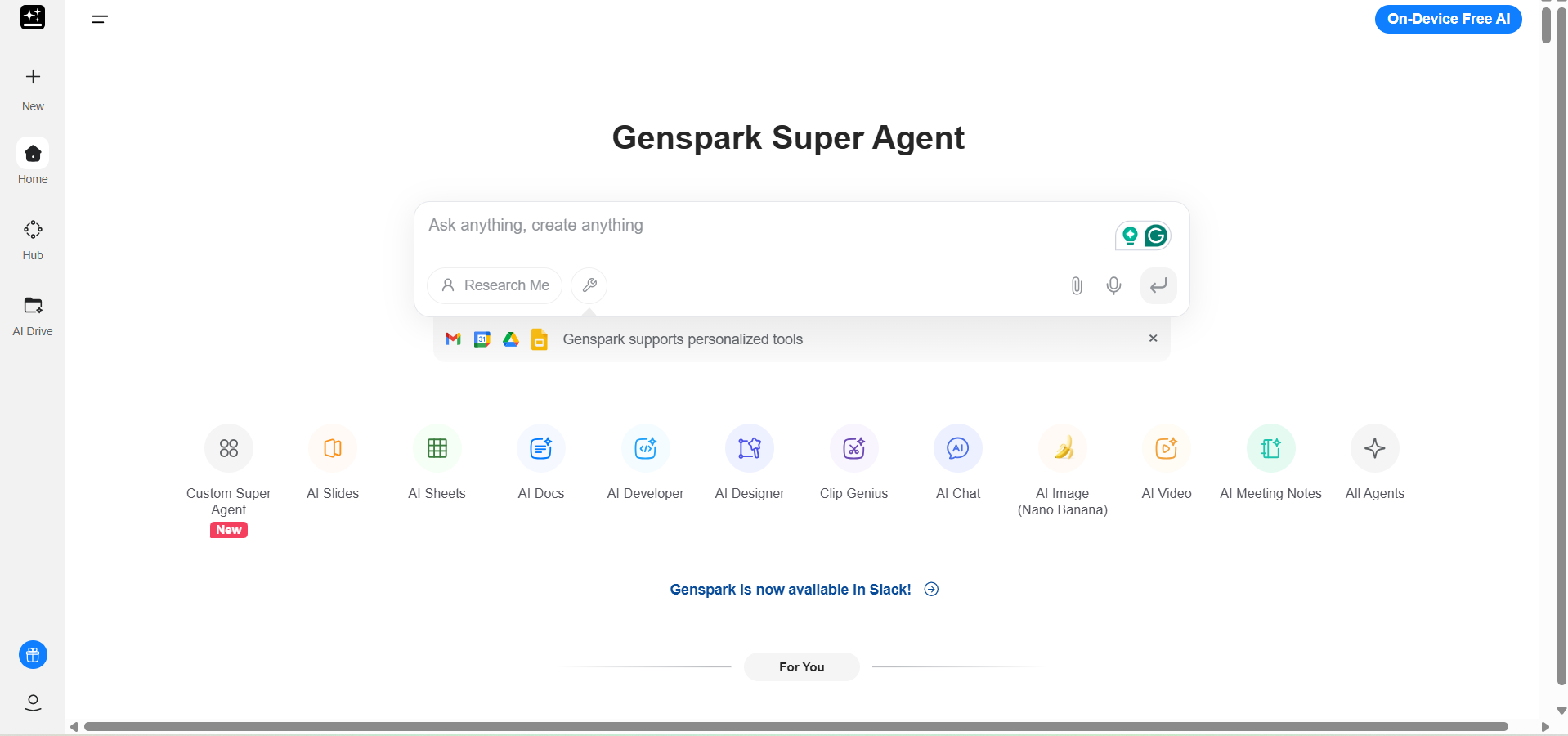
Need an AI Agent That Can Handle Any Task? Try HIX AI
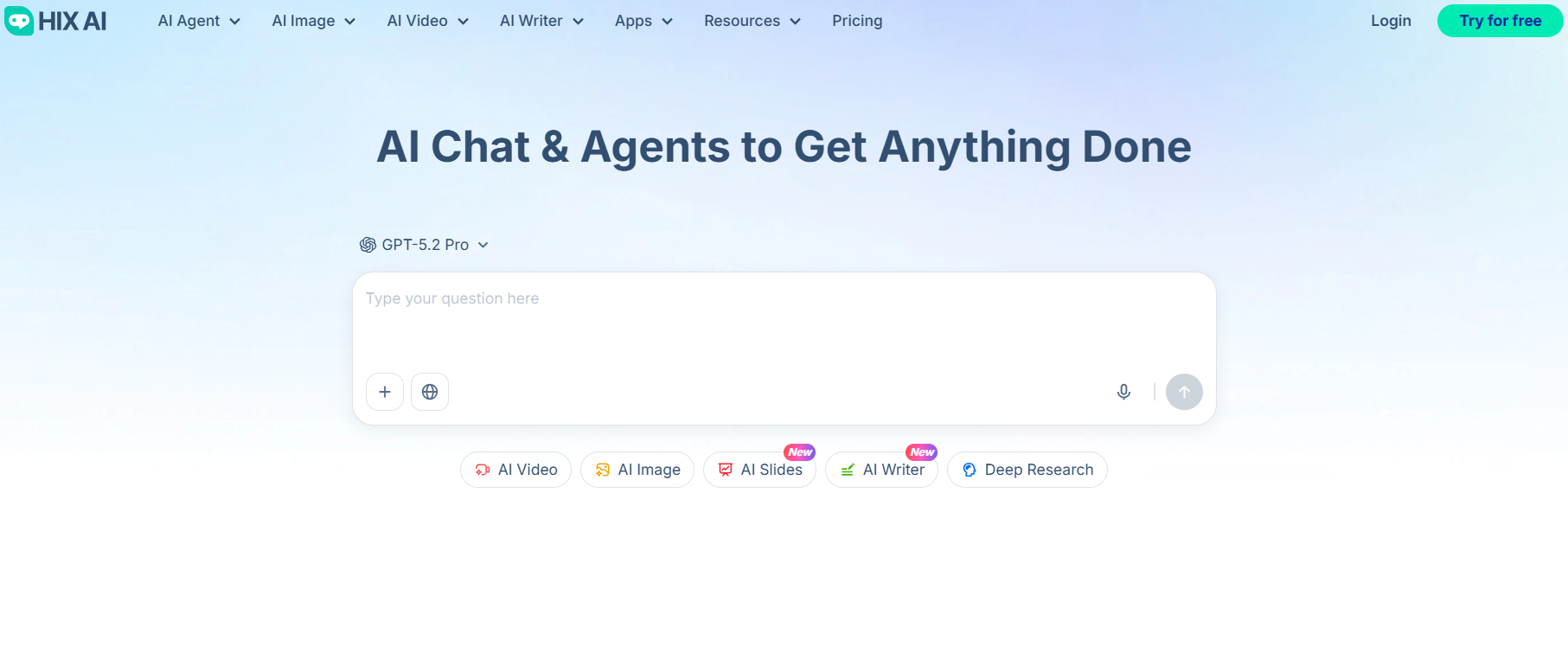
HIX AI is your ultimate AI agent workspace to boost your work and study productivity. Simply tell it your goal, and it will automatically plan the workflow, bring in the right agents, and complete the task from start to finish.
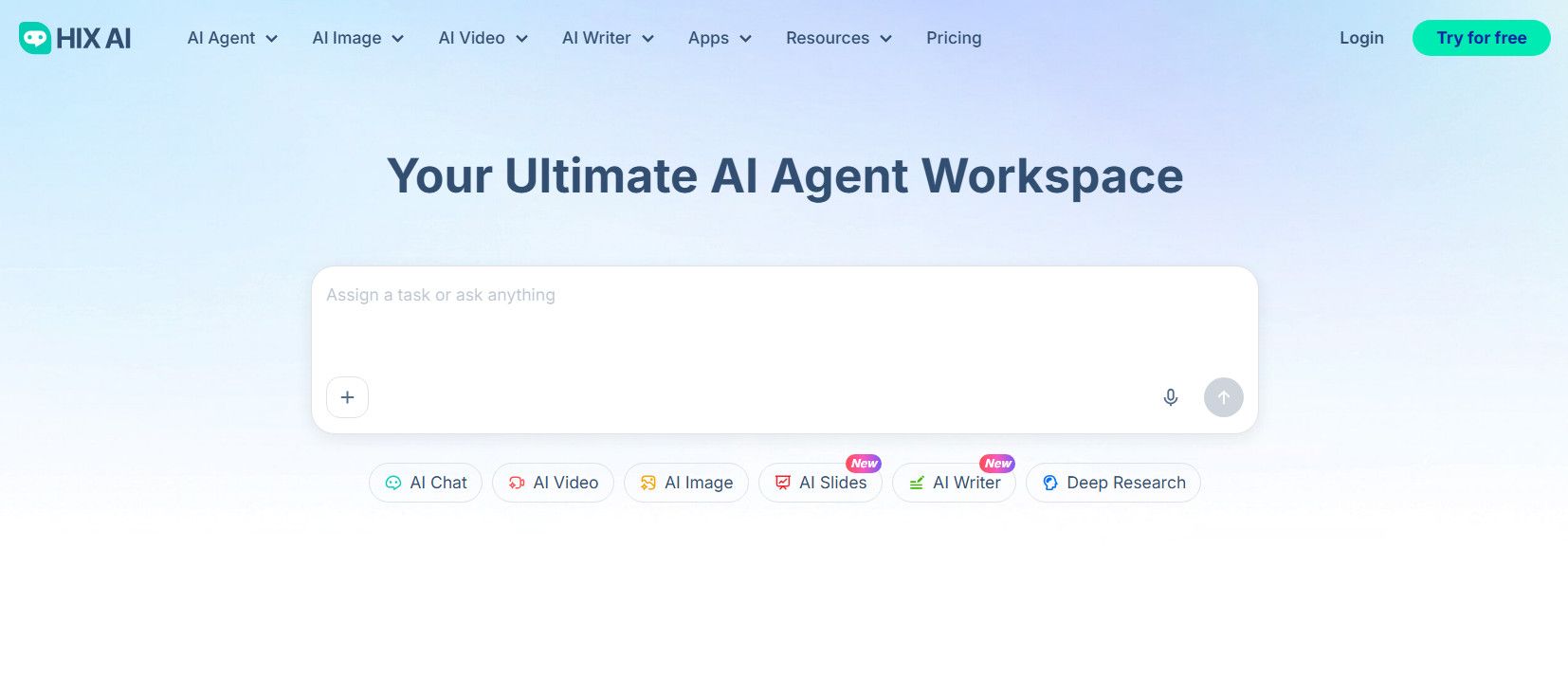
Its multi-agent system comes with subagents that work like experts. They are built for tasks like deep research, outlining, writing, coding, image, video slides creation agents.
Whether you're doing research, writing a report, presentation slides, producing marketing assets, building a website, HIX AI can handle all the steps and deliver high quality, working results.
⚡ Easy to Use • 💳 No Credit Card Required • 🌟 4.8/5 Rating
Where Are AI Agents Being Used Right Now?
These aren't just theoretical systems. AI agents are already embedded in real workflows across a range of industries. Looking at a broad sample of commercially available agent products, the use cases cluster into three main categories:
Research and information synthesis
This is the most common application. Instead of spending an afternoon trawling through reports, studies, or web pages, you hand that work to an agent. It gathers sources, cross-references information, pulls out what's relevant, and delivers a structured summary. For knowledge workers, this is a significant time-saver.
Workflow automation
Agents are showing up across business functions — customer support, HR, sales, IT operations. They move data between systems, trigger follow-up actions, route requests to the right place, and handle routine decisions.
The value here is that they free human workers from repetitive coordination tasks, leaving them with more time for judgment-heavy work that actually requires a person.
Browser and interface operation
Some agents can navigate websites and software interfaces directly — filling out forms, placing orders, booking appointments. This sounds mundane, but for anyone who's spent hours on repetitive data entry or multi-step online processes, it represents a real quality-of-life improvement.
One vivid real-world example: a customer support agent that listens to a caller's issue, asks follow-up questions, searches internal documentation, proposes a solution, and determines on its own whether the issue is resolved or needs to be handed off to a human. No script, no decision tree — just a goal and a loop.
Why Do People Actually Find Agents Useful?
The practical appeal comes down to a few things that compound nicely:
-
Scale.
A single agent can handle hundreds of tasks simultaneously. A human can't. For anything repetitive and high-volume, that's a meaningful advantage.
-
Consistency.
Agents apply the same logic every time, without fatigue, distraction, or mood. In rule-based workflows, that consistency is valuable.
-
Speed.
Automated multi-step processes run faster than manual ones, especially when multiple systems need to talk to each other.
-
Augmentation, not replacement.
The most realistic framing isn't that agents replace workers — it's that they absorb the tedious, repetitive steps so that human attention can go where it actually matters: creative judgment, relationship-building, ethical decisions, and the kinds of things that resist automation.
The Downsides of AI Agents — and They're Real
Here's where I want to be straight with you, because the hype around AI agents can get pretty thick.
Agents make mistakes. They reason incorrectly, miss context, or make poor judgment calls. And because an agent can act — not just reply — those mistakes can have real consequences. A wrong answer in a chat is annoying. A wrong action in a workflow can cause actual damage.
They can carry bias. Agents learn from data, and data reflects the world — including its flaws. If the training data is skewed, the agent's behavior will be too. Human oversight remains essential, not optional.
Over-automation is a real hazard. There's a temptation to hand off too much too fast. For high-stakes decisions — medical, legal, financial, safety-critical — the case for keeping a human in the loop is strong. Automating a workflow poorly can make things worse, not better.
Security matters more than you might think. An agent with tool access is touching real systems. Databases, email, software platforms — all of it. Organizations need to be deliberate about what permissions agents hold, what actions they're allowed to take, and how they're monitored. An agent operating without adequate guardrails is a liability.
Not everything called an "agent" actually is one. A lot of what's being deployed today is experimentation built on top of messy data, brittle processes, and infrastructure never designed for autonomous operation. The technology is genuinely promising — but some of the excitement is running well ahead of what's actually ready for production.
A Quick Word on "Agentic AI"
You'll hear this phrase alongside "AI agent," and they're closely related. "AI agent" usually refers to a specific product or software system. "Agentic AI" describes a broader design philosophy — building systems that reason, plan, and act toward goals, rather than simply responding to prompts. For practical purposes, they're pointing at the same underlying idea.
What's Coming Next for AI Agents
The near-term direction for AI agents is toward collaboration — multiple specialized agents working together on a task, with humans reviewing decisions at key checkpoints. Some enterprise platforms are already moving in this direction, combining agents that handle different parts of a workflow into coordinated pipelines.
But wider adoption won't come from better models alone. It'll come from trust — built through transparency, safety, and the careful, unglamorous work of connecting agents to clean data and reliable systems. The infrastructure question is just as important as the intelligence question.
The Bottom Line
An AI agent is an AI system that pursues goals by making decisions and taking actions — not just generating content. That distinction matters, because it changes what AI can realistically be used for, and what new responsibilities come with deploying it.
It's genuinely useful for multi-step, repetitive, or information-heavy work. It's also limited, fallible, and frequently overhyped. The most useful question you can ask about any claimed AI agent isn't whether it's "intelligent" — it's more practical than that:
What can it actually perceive? What decisions can it make? And what actions can it take?
Get clear answers to those three things, and you'll have a much better sense of whether you're looking at a real agent — or just a chatbot in a nicer coat.
And if you need an AI agent to tackle your work fast, you can try a smart AI agent, like HIX AI!
⚡ Easy to Use • 💳 No Credit Card Required • 🌟 4.8/5 Rating