
You've probably noticed that the phrase "AI agent" is now everywhere. Products that were called chatbots six months ago are now being marketed as agents. And the actual difference between an AI agent vs chatbot seems to have gotten blurry.
That gap — between what an AI says and what it can actually do — is exactly where the confusion between AI chatbots and AI agents begins.
So in this article, I try to help you untangle these two concepts clearly. By the end, you'll know what each term actually means. And you'll also know which one fits different situations, and why neither AI agent or chatbot is magic for now.
12 best AI agents
- AI Agent vs Chatbot: What Their Actual Difference Is
- What an AI Chatbot Does Well
- What Makes an AI Agent Different
- A Side-by-Side Comparison
- When a Chatbot Is the Right Choice
- When an AI Agent Is the Right Choice
- Looking for an AI Agent to Boost Your Productivity?
- Limits, Risks, and What to Watch For
- The Simplest Way to Remember It
AI Agent vs Chatbot: What Their Actual Difference Is
Here's the most useful one-line distinction you'll find:
A chatbot helps through conversation. An agent helps through conversation plus action.
What is an AI chatbot
An AI chatbot — specifically the modern kind powered by a large language model — is built primarily for interaction.
It receives your message and generates a response. It can answer questions, explain ideas, help you draft an email, summarize a document, work through a problem with you step by step, or guide you through a troubleshooting process. It's responsive, often impressively so.
But notice the pattern: it responds. A chatbot is, at its core, a reactive tool. You prompt it, it replies. That's not a weakness — it's a design. Most chatbots are optimized for the quality of that response, not for what happens after it.
What is an AI agent
An AI agent is built around a different idea. Its job isn't just to reply — it's to pursue a goal. When you assign an agent a task, it can break that task into steps, figure out what it needs to accomplish each one, reach out to tools or systems to get information or take action, and work through the process with varying degrees of independence.
AI agents use memory to track where they are in a workflow, tool access to interact with external systems, and a degree of autonomy to make decisions along the way.
That's the key trio: memory, tool use, and autonomy. Together, they're what turn a conversational AI into something that can actually operate.
Read more: What is an AI agent
It's also worth noting that these categories aren't perfectly sealed. Some chatbots have lightweight agent-like features. Some agents use a chat-style interface. In the real world, the line can blur — but the underlying distinction still holds, and it still matters.
What an AI Chatbot Does Well
Modern LLM-powered chatbots are a significant leap beyond the scripted bots of five years ago. They can hold nuanced conversations, handle unexpected questions, and generate thoughtful, context-aware responses. For a wide range of everyday tasks, they're genuinely excellent.
Chatbots shine when the job is to:
-
Answer questions
From simple factual queries to detailed explanations of complex topics
-
Summarize information
Paste in a long article, a report, or an email thread and get the key points fast
-
Brainstorm and draft
Generate ideas, write first-pass content, help you refine your thinking
-
Guide troubleshooting
Walk someone through a process step by step
-
Handle high-volume support interactions
Respond to common customer questions at scale, consistently
What Makes an AI Agent Different
An agent doesn't just describe the steps — it takes them.
Imagine you tell an AI: "Help me prep for my team meeting this afternoon." A chatbot might ask a few questions and then help you draft an agenda. That's useful. An agent, given the right access, might pull in your recent project notes, check what action items are still unresolved from last week, flag any calendar conflicts, and deliver you a ready-to-use briefing document — without you managing each step.
That difference — from talking about the task to working through it — is what agency means in practice.
Agents accomplish this through three practical capabilities:
-
Memory and context
Agents can track where they are in a multi-step process and retain relevant information across steps or sessions. They don't start from scratch with every exchange.
-
Tool use
Agents can connect to external systems: APIs, databases, calendars, ticketing platforms, communication tools, and more. They're not confined to what they know; they can go out and get what they need.
-
Autonomy within boundaries
Agents can make decisions about what to do next. This doesn't mean unlimited independence — most well-designed agents operate within clear rules, permissions, and approval requirements. But within those guardrails, they can act.
This last point is worth emphasizing: "agent" does not mean "fully autonomous AI doing whatever it wants." The best-designed agents are deliberately constrained. Human oversight remains part of the picture, especially when actions affect real systems or real data.
A Side-by-Side Comparison
| Aspect | AI Chatbot | AI Agent |
|---|---|---|
| Primary role | Converse, answer, guide | Pursue goals, complete tasks, coordinate steps |
| How it's triggered | Waits for a prompt | May continue through a workflow once assigned a task |
| What it produces | Information, suggestions, drafted text | Actions, updates, completed steps — plus explanations |
| Tool access | Limited or optional | Often central to how it works |
| Best task complexity | Simpler interactions, single-turn help | Multi-step tasks with dependencies |
| Risk level | Lower — it informs, not acts | Higher — it can change records, trigger workflows |
The distinction here isn't about intelligence. A chatbot can sound remarkably intelligent. The real question is simpler: can it do anything beyond generating a response? That's the dividing line.
When a Chatbot Is the Right Choice
Don't let the excitement around agents oversell you on complexity you don't need. For a large portion of real-world use cases, a well-designed chatbot is genuinely the better fit.
Choose a chatbot when:
- The goal is to inform, explain, or converse — getting answers, learning something new, working through an idea
- The task involves high-volume, repetitive questions that benefit from consistent, scalable responses
- You want something easy to deploy and supervise without the overhead of tool integrations and workflow design
- Users need guidance before escalating to a human — chatbots are excellent at collecting context and routing effectively
A practical rule of thumb: if the main job is to produce the right words, a chatbot may be all you need. The risk to avoid is assuming that because it communicates naturally, it can also act reliably. Those are different capabilities, and confusing them leads to misplaced trust.
When an AI Agent Is the Right Choice
Agents earn their keep when work has to move past conversation and into execution.
Consider the difference between understanding a process and running it. A chatbot can walk you through how a support ticket gets resolved. An agent can receive the ticket, check relevant account data, apply business rules, escalate to the right team if needed, send an update to the customer, and log the outcome — automatically.
Agents are the better fit when:
- The task involves multiple steps with dependencies — things that need to happen in sequence based on real-time information
- You need to pull from or write to external systems — databases, APIs, communication platforms, business tools
- The work is repetitive but still requires judgment — following logic that would take a human real effort to apply consistently at volume
- You want proactive monitoring and action — not waiting for a prompt, but watching for conditions and responding when they occur
The most effective early uses for agents tend to be well-defined, constrained tasks rather than open-ended autonomy. A clear objective, reliable system access, and defined approval paths make agents work best. The more ambiguity in the task and the higher the stakes of errors, the more human oversight matters.
Looking for an AI Agent to Boost Your Productivity? Try HIX AI!
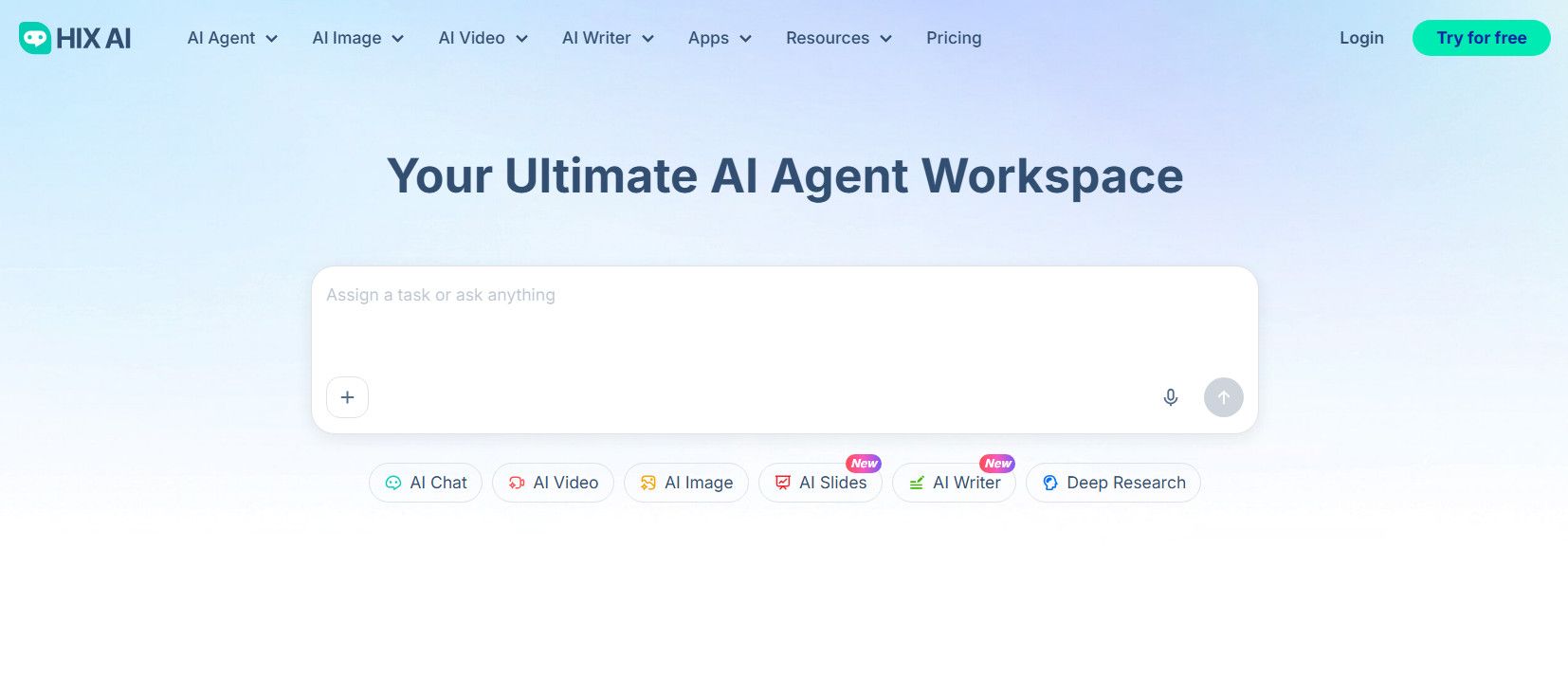
HIX AI is your ultimate AI agent workspace for your work or study. It can help you deal with complex, multi-step tasks. Simply tell it your goal, and it automatically plans the workflow, executes the steps and delivers the high quality results you need.
HIX AI comes with multiple intelligent subagents specialized for deep research, AI slides, AI image, AI video, AI writing, and AI coding. It coordinates the right agents for any job, so your work gets done end to end.
HIX.AI
4.9/5.0
Your ultimate AI agent workspace to boost your work and study productivity.
- Handle complex, multi-step tasks with simple prompts.
- Multiple expert-like subagents coordinated to complete your tasks.
- Powered by cutting-edge AI models.
- Research deeply and create professional reports/slide decks.
- Create on-brand, consistent marketing assets in one flow.
- Generate publish-ready visual documents and functional code.
Limits, Risks, and What to Watch For
Both categories have real limitations — and both are capable of failing in ways that aren't always obvious.
Chatbots can sound confident while being wrong. Language models generate fluent text; they don't guarantee accurate text. The smoother the response, the easier it is to miss an error. Always verify anything consequential.
Agents can make mistakes at a greater scale. Because they're connected to tools and systems, an error in reasoning or a missed edge case can propagate into actual changes — updated records, sent messages, triggered workflows. The cost of failure is higher.
Before trusting any AI product, ask:
- Does it only answer, or can it actually act? Know which you're dealing with.
- What systems can it access? The more connections, the more potential for unintended consequences.
- What approvals or safeguards exist? Any well-designed agent should have them.
- Can a human review or override its actions? This is non-negotiable for high-stakes tasks.
- Is it meant for simple guidance or multi-step execution? Match the tool to the job.
One more thing worth saying plainly: "agent" is not always a meaningful label. Sometimes it describes a genuinely capable system with real tool integrations and workflow logic. Sometimes it's mostly a marketing term. Ask what the system can actually do before assuming the name tells you.
The Simplest Way to Remember It
A chatbot mainly talks with you.
An agent talks with you and takes steps to get something done.
Neither is universally better. A chatbot is often exactly what you need — and easier to deploy, supervise, and trust. An agent becomes the right choice when the task genuinely requires moving from conversation to action, from explaining to executing.
As AI tools keep evolving, the line between these two will blur further in products and marketing. But the underlying question will stay the same: Is this AI informing me, or is it operating on my behalf?
That question cuts through the hype — and it's worth asking every time.
And if you need an AI agent to handle complex tasks of your work or study, just give HIX AI a try! It's your ultimate AI agent workspace to get your job done end to end!
⚡ Easy to Use • 💳 No Credit Card Required • 🌟 4.9/5 Rating